
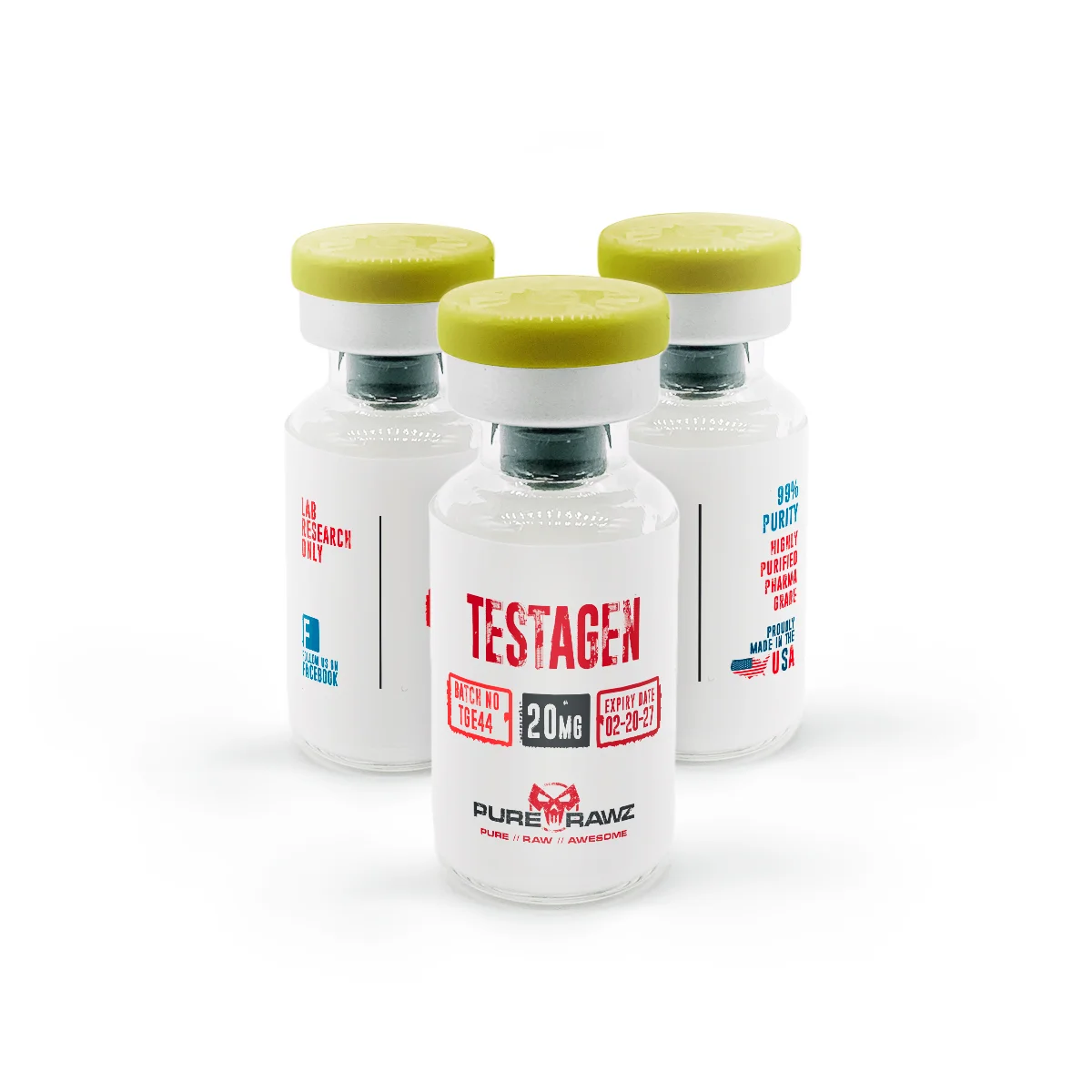
Testagen for Sale | 3rd-Party Tested Pure | Purerawz Testicular Research Peptide
What is Testagen?
Among the growing family of organ-specific peptide bioregulators, Testagen occupies a uniquely focused position in male reproductive biology research. Originally derived from bovine calf testicular tissue and now synthetically produced for laboratory use, Testagen belongs to the specialized class of compounds known as cytomedins, small regulatory peptides engineered to influence tissue function at both the cellular and genetic level.
What distinguishes Testagen from hormone-based research compounds is its tissue-specific targeting behavior. Rather than stimulating the pituitary gland or directly elevating testosterone levels, Testagen is believed to operate at the cellular and genetic level within testicular tissue itself, making it a precision research tool for scientists studying spermatogenesis, Leydig cell activity, and testicular cell renewal in preclinical models. All products on Purerawzus.com are strictly intended for laboratory and research use only and are not approved by the FDA for human or veterinary use.
Testagen Chemical Properties
|
Property |
Details |
|
Product Name |
Testagen |
|
Classification |
Cytomedin, Organ-Specific Peptide Bioregulator |
|
Origin |
Synthetically derived from bovine testicular tissue |
|
Tissue Specificity |
Testes in experimental research models |
|
Storage |
-20°C or colder, up to -80°C for long-term preservation |
|
Solution Storage |
2°C to 8°C refrigeration after reconstitution |
|
Research Use |
Laboratory and Scientific Research Only |
|
Regulatory Status |
Not approved by the FDA for human or veterinary use |
How Does Testagen Work?
Scientific investigation into Testagen has revealed a distinctive intracellular mechanism that sets it apart from conventional hormone-based research compounds. Researchers have observed that Testagen specifically targets testicular cells and operates through the following key mechanisms in preclinical models:
Chromatin Interaction and Gene Activation
Upon entering the cell nucleus Testagen interacts directly with chromatin, the DNA-protein complex responsible for regulating gene activity in preclinical models. By binding to regulatory regions of chromatin Testagen may help activate genes specifically required for spermatogenesis and testicular cell renewal in experimental settings.
Leydig Cell and Protein Synthesis Support
Beyond chromatin interaction researchers have observed that Testagen may activate Leydig cell function and support protein synthesis processes necessary for normal testicular activity in research models.
|
Potential Mechanism |
Research Context |
|
Nuclear Entry and Chromatin Binding |
May enter the cell nucleus and bind to chromatin regulatory regions |
|
Spermatogenesis Gene Activation |
May help activate genes required for sperm production in research models |
|
Testicular Cell Renewal |
May support testicular cell renewal processes in preclinical experimental settings |
|
Leydig Cell Activation |
May activate Leydig cell function involved in hormone production regulation |
|
Protein Synthesis Support |
May support protein synthesis processes essential for normal testicular activity |
|
Cellular Level Action |
Works at cellular and genetic level rather than through pituitary stimulation |
Potential Benefits of Testagen in Research
Early stage scientific investigation has identified several areas where Testagen may offer significant research value in preclinical and experimental laboratory settings:
|
Potential Benefit |
Research Context |
|
Spermatogenesis Research |
Being studied for its possible role in activating genes related to sperm production |
|
Testicular Cell Function Research |
May support research into testicular cell behavior and functional optimization |
|
Leydig Cell Research |
Being explored for its possible role in activating Leydig cell activity in research models |
|
Male Reproductive Biology Research |
Valuable tool for studying male reproductive tissue function at the cellular level |
|
Hypogonadism Research |
Being investigated for possible applications in studying testosterone deficiency models |
|
Cellular Gene Expression Research |
May support research into chromatin-level gene regulation in testicular tissue |
|
Anti-Aging Reproductive Research |
Being explored for its possible role in age-related testicular function decline research |
|
Hormonal Regulation Research |
Studied for its possible influence on hormonal balance through cellular mechanisms |
Please note: All benefits listed are based on early stage preclinical research. This product is strictly intended for research purposes and is not approved for human or veterinary use.
Potential Research Areas of Testagen
|
Research Area |
Potential Focus |
|
Spermatogenesis Research |
Studying how Testagen may activate genes required for sperm production in research models |
|
Leydig Cell Research |
Investigating its possible role in Leydig cell activation and hormone production regulation |
|
Testicular Cell Biology Research |
Exploring its possible influence on testicular cell renewal and functional optimization |
|
Male Reproductive Health Research |
Studying its possible applications in male reproductive biology and fertility research |
|
Chromatin Regulation Research |
Investigating its possible interactions with chromatin and DNA-protein regulatory complexes |
|
Gene Expression Research |
Studying its possible role in activating tissue-specific genes in testicular research models |
|
Hypogonadism Research |
Exploring its possible applications in testosterone deficiency and hypogonadism research |
|
Anti-Aging Research |
Investigating its possible role in age-related testicular function and longevity research |
|
Hormonal Balance Research |
Studying its possible influence on endocrine regulation through cellular mechanisms |
|
Oxidative Stress Research |
Exploring its possible protective effects on testicular cells against oxidative damage |
Handling and Storage of Testagen
Proper handling and storage of Testagen are essential for maintaining compound integrity and ensuring reliable research outcomes across all study periods:
|
Condition |
Recommendation |
|
Primary Storage |
Store in a tightly closed container at -20°C or colder |
|
Long-Term Storage |
Store at -80°C for extended preservation periods |
|
Room Temperature Stability |
May remain stable for several days to weeks at room temperature or 4°C |
|
Pre-Opening Protocol |
Allow vial to reach room temperature in a desiccator before opening to prevent condensation |
|
Reconstituted Solution Storage |
Store at 2°C to 8°C refrigeration after mixing with solvent |
|
Post-Reconstitution Stability |
Stability decreases significantly once mixed with solvent such as bacteriostatic water |
|
Moisture Prevention |
Keep away from moisture and humidity at all times during storage and handling |
Where to Buy Testagen Online
Pure raws is your trusted source for research-grade Testagen. Every product we supply is first and third-party tested and backed by a full Certificate of Analysis confirming identity, purity, and concentration for complete research compliance. We offer multiple secure payment options to make your ordering experience seamless from start to finish. Visit our how to pay page for a complete step by step guide to all available payment methods and secure checkout instructions.
|
Feature |
Details |
|
Testing |
First and independent third-party lab tested |
|
Documentation |
Certificate of Analysis (COA) included with every order |
|
Shipping |
Free international shipping on orders over $100 |
|
Payment Options |
Multiple secure payment methods available |
|
Support |
24/7 expert customer support |
Frequently Asked Questions
Is Testagen Safe for Human Consumption?
No. The FDA has not approved Testagen for human or veterinary use. Purerawzus.com supplies this compound strictly for laboratory and scientific research purposes only.
What Side Effects Have Been Observed With Testagen?
As Testagen remains under active scientific investigation its complete side effect profile has not yet been fully established. Researchers are encouraged to follow all applicable laboratory safety protocols when handling this compound. Further studies are required to confirm safety findings.
How Should Testagen be Stored?
Store Testagen in a tightly closed container at -20°C or colder with -80°C recommended for long-term preservation. Before opening allow the vial to reach room temperature in a desiccator to prevent condensation. Once reconstituted store the solution at 2°C to 8°C as stability decreases significantly after mixing with solvent.
Is Testagen Legal for Research Use?
Testagen is legal for laboratory and research use in applicable regions. The FDA has not approved it for human or veterinary applications. All research must comply with applicable institutional standards and local regulatory guidelines before purchasing or using this compound.
How Does Testagen Differ From Testosterone-Based Research Compounds?
Unlike testosterone-based research compounds Testagen does not stimulate the pituitary gland or directly influence testosterone levels in research models. Instead it operates at the cellular and genetic level within testicular tissue by interacting with chromatin and activating tissue-specific gene expression pathways. This distinction makes Testagen a unique precision research tool for studying testicular cell biology independently of hormonal signaling pathways.
Disclaimer
All information on this page is provided for educational purposes only and does not constitute medical or professional advice. Products are for laboratory and research use only. By ordering you agree to our Terms and Conditions. Contact us at sales@purerawzus.com for any concerns.
All products are for laboratory and research purposes only and are not intended for veterinary or human use.
References
Aurelian Dobriţescu, Samide, A., Nicoleta Cioateră, Oana Camelia Mic, Ionescu, C., Dăbuleanu, I., Cristian Tigae, Cezar Ionuţ Spînu, & Oprea, B. (2025). The Inhibitory Effect and Adsorption Properties of Testagen Peptide on Copper Surfaces in Saline Environments: An Experimental and Computational Study. Molecules, 30(15), 3141-3141.
Be the first to review “Testagen”
Related products

Peptides

Peptides

Peptides
Peptides
Peptides

Peptides

Peptides
Peptides
Reviews
There are no reviews yet.